Visiting Japan (東京マラソンを走る)
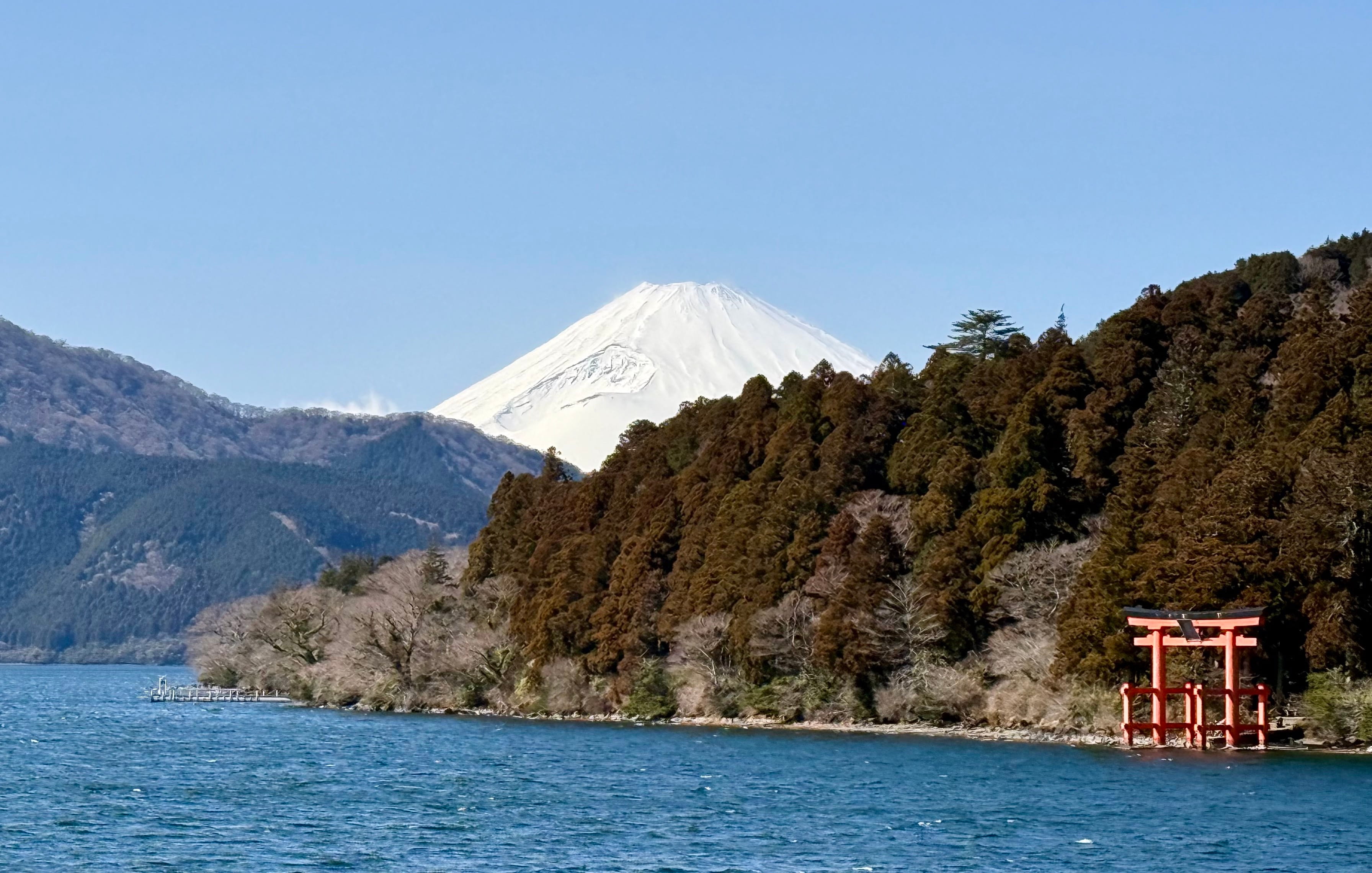
For years, I had wanted to visit Japan, but cycling trips in Europe always seemed more tempting and kept winning out. Then, the day before the Tokyo Marathon lottery closed, a friend convinced me to apply. I didn’t expect much, but a few months later I received the email: I was selected.
In case you can’t read Japanese, 東京マラソンを走る translates to “running the Tokyo Marathon.” What followed was a winter of training in snowy New York, a jet-lagged flight across the world, and eventually my first attempt at the marathon distance.
Ready for First Marathon!?
My running history starts in 2023, when a friend suggested we sign up for a 10K. I had never even run a 5K before, so I started a Couch-to-10K program in January 2023 with a goal of breaking 50 minutes by March. Given my cycling training, cardio was not the bottleneck, but my tendons were not primed for running. Like many beginner runners, I treated every run like a race - getting injured, taking a few days off, and repeating the cycle. Nonetheless, I hit my goal running a 49:56 in my first race!
After that, I took a pause for a few months. The week before a half-marathon, I #YOLO signed up and paid for it, blowing up and getting a disappointing 2:10. Since then, I started a more proper training program in 2024 incorporating easy runs and intervals, which steadily improved my running performance.
Fast-forward to late 2025: I was running 2–3 times per week and felt reasonably comfortable at moderate distances. Definitely not marathon shape, but something to work off of.
Training Strategy
I didn’t follow a traditional marathon training program. Instead, I devised one where I’d gradually add more mileage and cross-train on the indoor trainer bike. On February 1st, I would check-in on my progress through the Manhattan 10K where I was hoping for a sub-44. My goal was to hit ~40mpw as peak mileage.
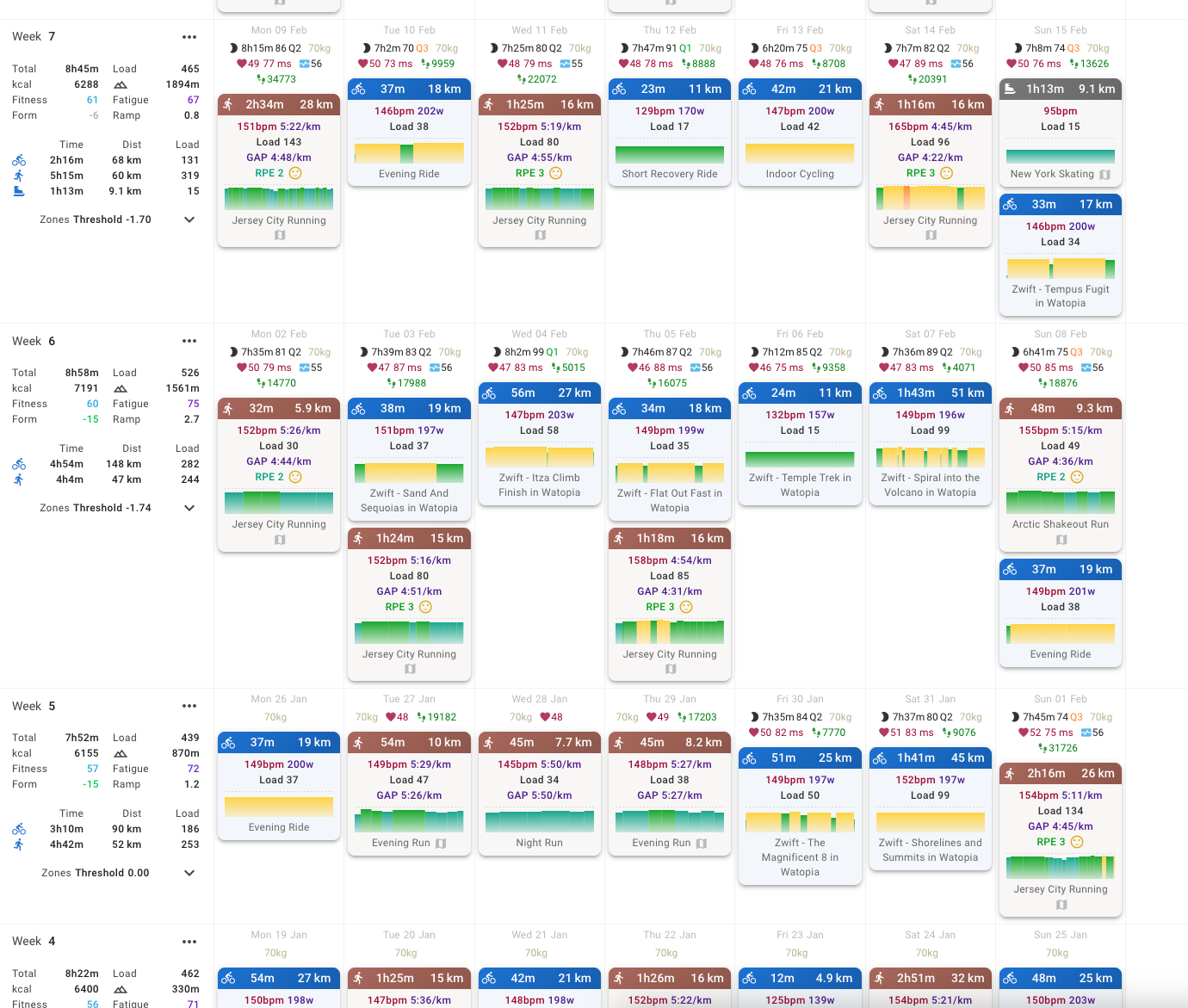
My training calendar - I had quite good recovery from all the zone-2 volume (you can see my resting heart-rate was below 50bpm for most nights and HRV above 80ms which for me is good recovery)
The main issue in the training block was the cold and snowy New York winter. In the 2025/2026 winter, there was more than 3x the amount of snow from the previous year and almost 2x the snow of a regular winter. Icy conditions and extreme cold made it difficult to do long runs and workouts before/after work. In fact, it was so bad that the Manhattan 10K was even cancelled this year due to the cold.
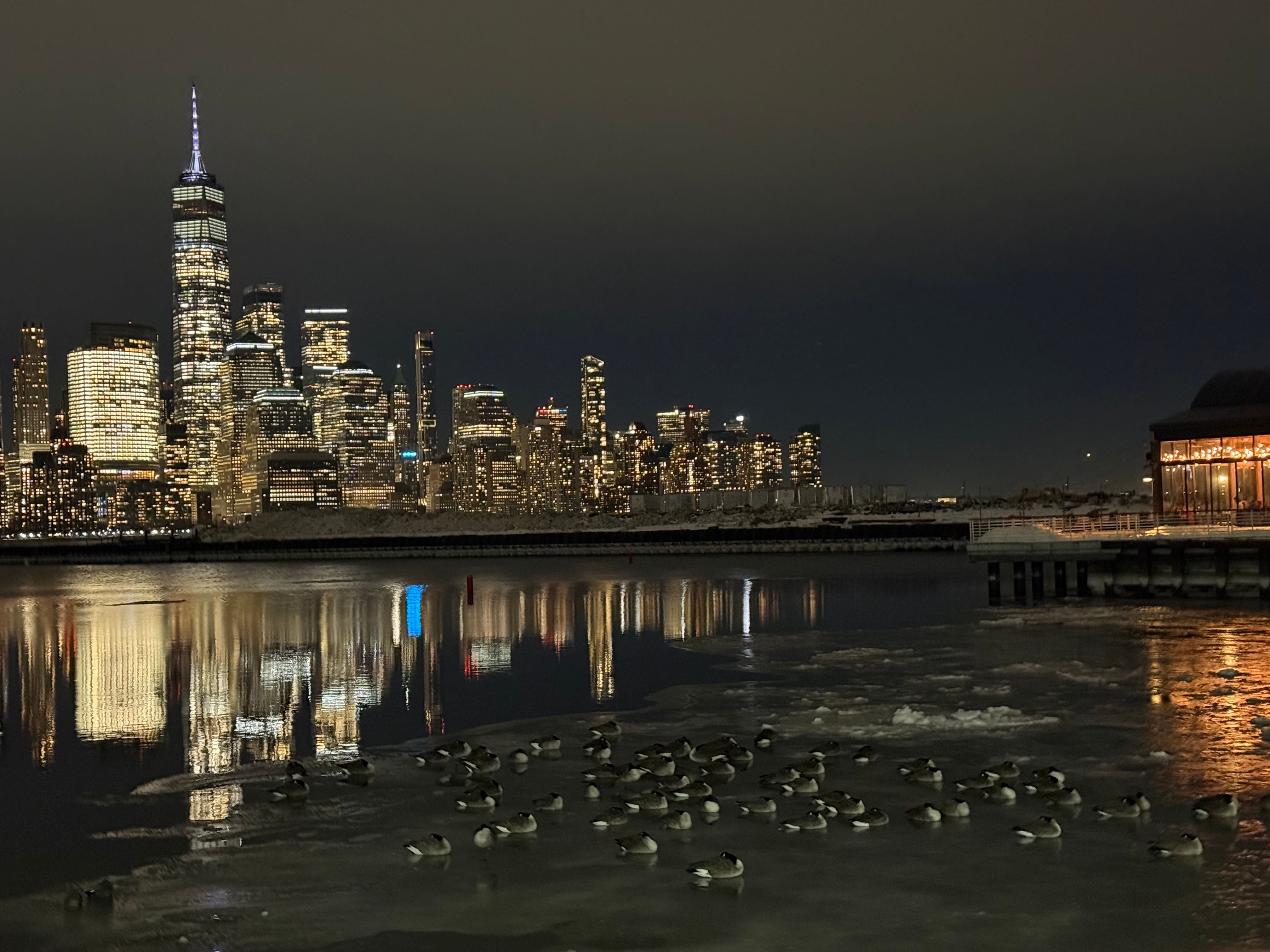
Geese sleeping and enjoying the view on a Hudson River Iceberg in Jersey City. Passed by this view on every run for my training block
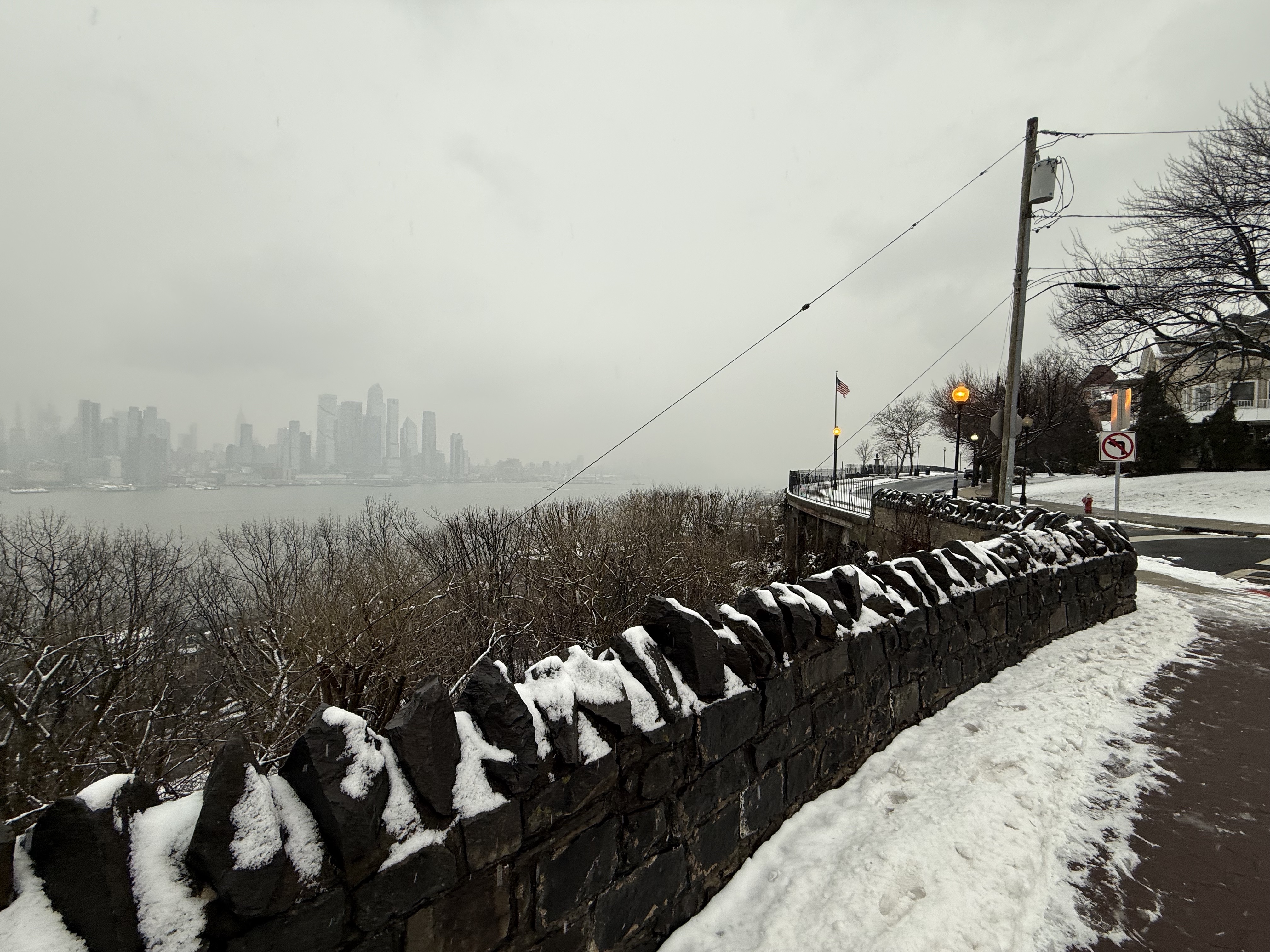
Lesser known running route in North Bergen above the Palisades. The roundtrip 26km+ run felt like an adventure every time, passed through numerous towns and super steep hills
From the late-nights of running in freezing weather, long runs where my water bottle would turn into a block of ice, running in 1km loops in traffic because of unplowed sidewalks - the training cycle definitely had a distinct vibe. Maybe not for everyone, but I still enjoyed it.
Overall, I was satisfied with my training and resiliency given the weather, and felt strong. I had a streak of 43 days of running/cycling, with several double-days. I still went to the gym 4x a week during the training block to lift and maintain strength. I lost ~5lbs total throughout all of this which wasn’t ideal, but my Garmin predicted time was 3:23 and Strava gave a 3:33 so I figured 3:30 could be in the cards!
Pre-Tokyo Marathon Plan
With the training and feeling prime, I flew in 3 days before the marathon … or so I thought, but it was miscalculated and I actually flew in two days before because I lost a day due to time zones (yes, I studied math in undergrad). The flight was rough, I had a window seat but couldn’t get up as much as I wanted.
Due to a snowstorm, the flight was delayed three hours on the runway. In total, I ended up spending 17 hours on the plane. After arriving, I got slightly sick - perfect timing after not getting sick for over a year! Sore throat, a lot of coughing, congestion. I didn’t have any medication, so went to Japanese pharmacies to get some things for a cold and Vitamin C. Unfortunately, nothing was in English so I struggled reading instructions with ChatGPT saying to take 3 pills 3x a day, Google translate saying 5 pills 2x a day…
It’s safe to say the trip there was rougher than I thought. The hotel room also didn’t have A/C turned on (supposedly the hotel only turns it on in April), so I could barely sleep. Doesn’t help that I was 13 hours jet-lagged either.
The day before, I had bib pickup at the expo and a half-marathon relay shakeout with my dad the night before the actual marathon. The expo was busy and crowded. The relay was quite fun, you pass around the green baton belt. You can read more about the Japanese culture of relays races, called Ekiden. Doing it sick was not great, but got it done. Waiting sweaty in the cold after my shift, didn’t help in feeling better.
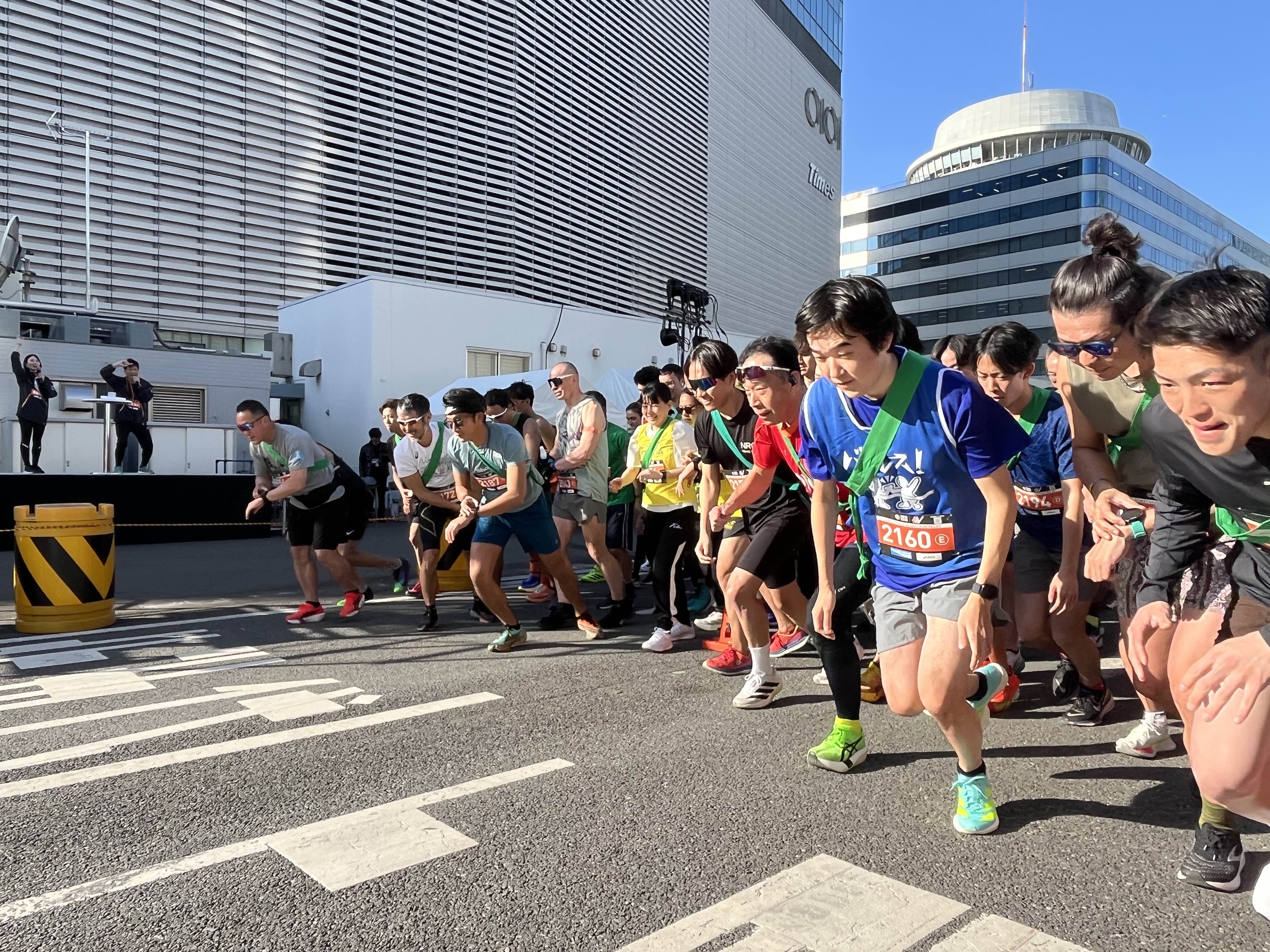
Start of the Half-Marathon Relay. I did 5km of the shake-out (~5:30min/km) and my dad finished 16km (~4:59min/km). In my defense I had to run a full marathon the next day 😛
Overall, felt a bit shaky coming into the marathon. After some all-you-can-eat sushi with friends and pasta, I was hoping to feel better and sleep well the night before the marathon!
Race Day Strategy & Execution
My original race plan was to aim for 3:30, but after getting sick I had no idea how the race would go. My strategy was to take it very easy the first km, if I feel good aim for 1:45 half-marathon, and then go all out in the last half. While signing up for the race I put a 4:15 expected time by accident, putting me far back in Corral G. This posed a problem for my 3:30 goal.
After not sleeping the night before (Garmin sleep score 44), and being sick, I woke up already exhausted. Luckily, my hotel was right beside the start-line so I saved some energy from the commute. After getting to the start, I thought to use the washroom before the race, but the lines were long and I started in Corral J unintentionally. These were costly mistakes, and I lost a lot of time to weaving and getting blocked by people - especially at the water stations, where most walked and blocked access to it. On the other hand, there was mental boost for passing so many people constantly.
The first km was very crowded, but I felt surprisingly OK running. I picked up the pace after, hitting my goal of ~1:45 for the first half marathon and felt surprisingly great, and not tired at all. The crowds were incredible, and once I settled into the rhythm of the race I almost forgot I was sick!
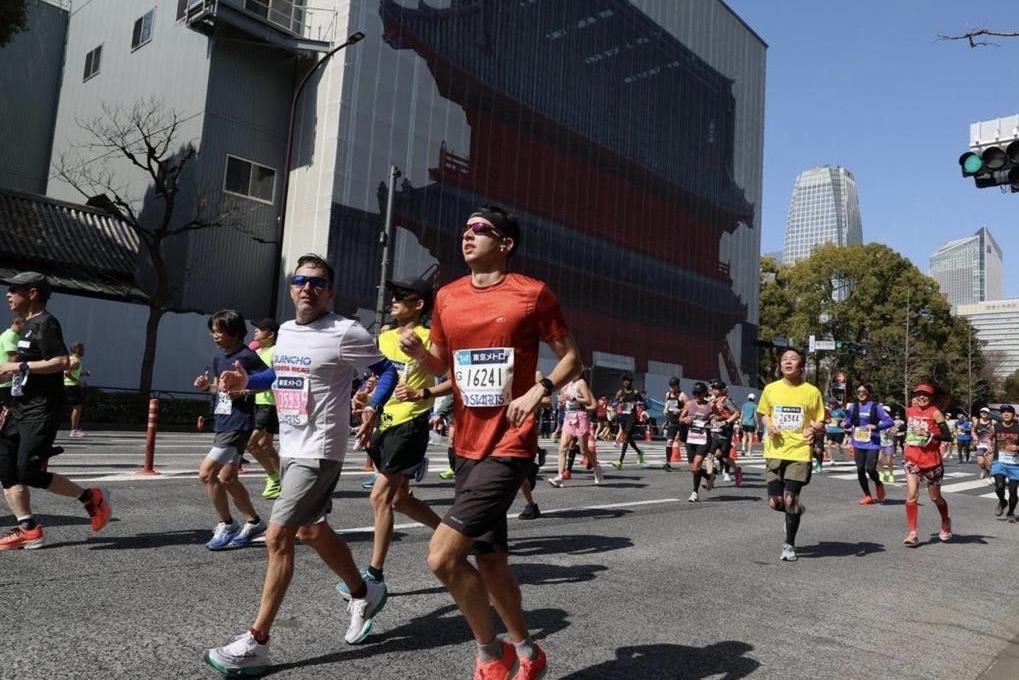
Running around Ginza, right around the Tokyo tower (~35km)
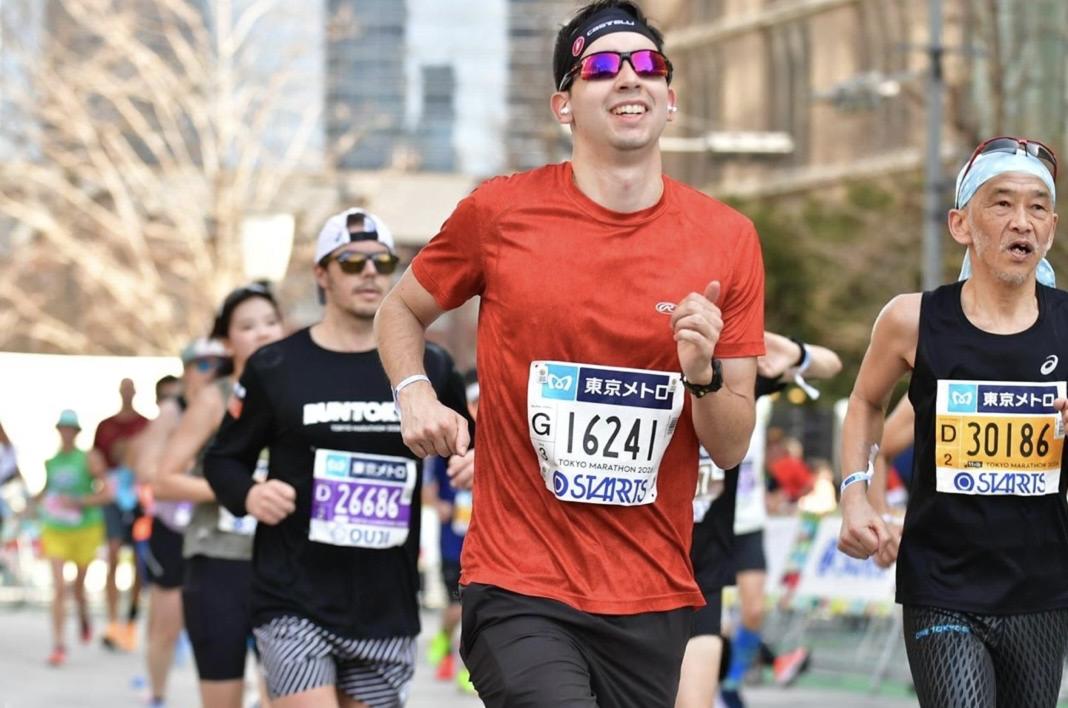
The final stretch of the race (~40km). You can see that I had Corral G (for 4:15 expected time) but caught up with Corral D (3:30) towards the end of the race
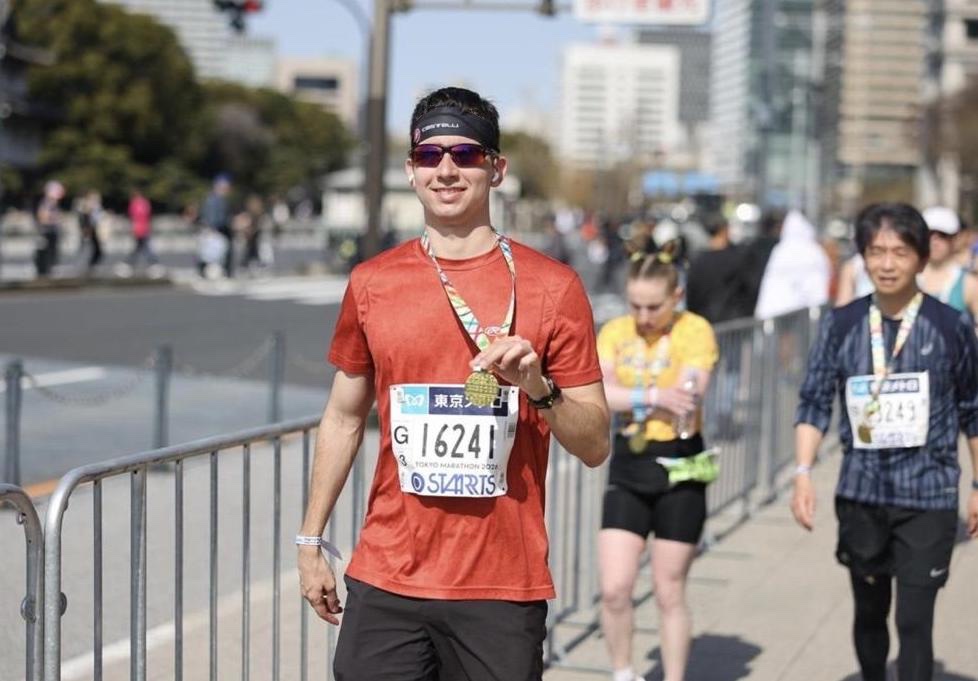
Picture at the finish with the Tokyo Marathon 2026 medal
I maintained a fairly low HR (~159bpm average for the half marathon). After 30km, I started to feel knee pain, which I never felt in training. My feet swelled up, and started pressing against the tip of my Vaporflies, which resulted in black nails and was painful. Come 37km, I started to get dehydrated since it got warm (66ºF) and I was skipping water stations since it would cost too much time.
However, I powered through and felt very strong at the end. The last km was on a cobblestone road that was narrow and felt like a speed-tunnel, as the finish was at the very end and since I had a lot of energy left. Starting so far back meant I spent most of the race weaving through runners - it cost time, but there was also something strangely motivating about constantly passing people for 40 kilometers. Crossing the finish line, after months of winter training, felt surreal - the kind of moment that makes all the miles feel worth it.
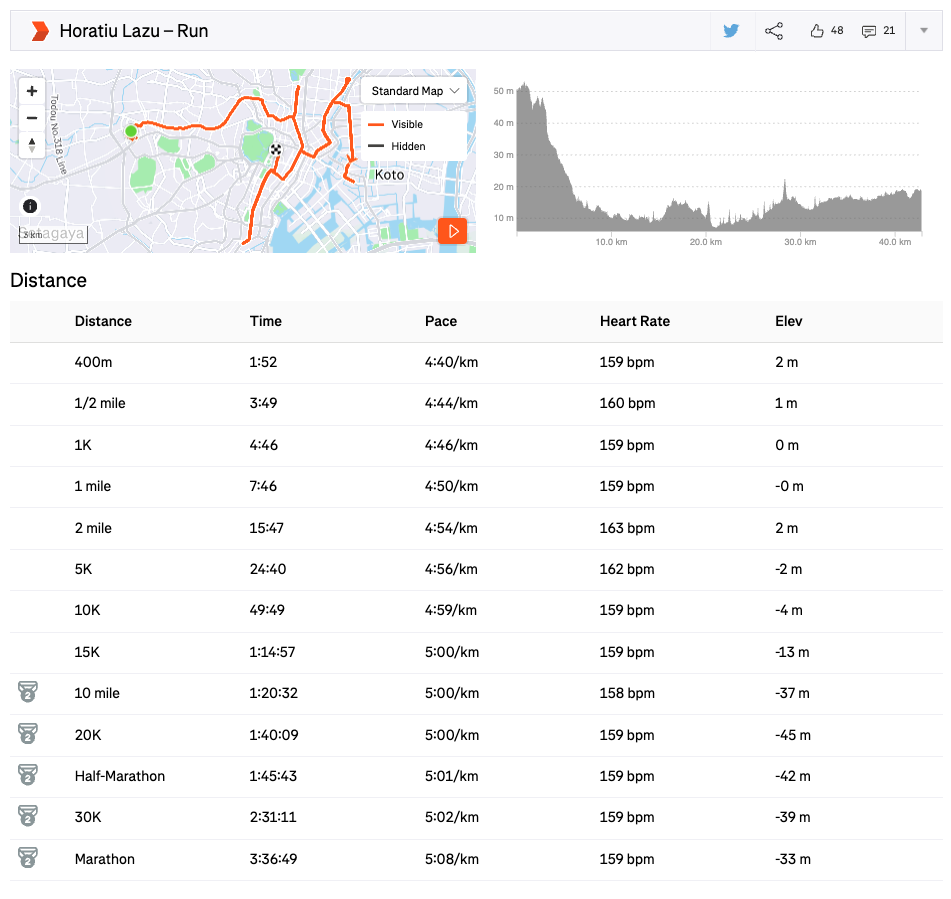
Felt quite good until 30km. It is quite common to say that the marathon really only starts at 32km, where you hit the real bottleneck. For me, it was knee pain, and my feet swelled up and pressed against my Vaporflies which resulted in black nails. My aerobic base training and fueling were seemingly on-point otherwise
Overall, I would consider this a successful first full-marathon, having avoided the wall and no major issues! I got an official time of 3:40:06. While I missed my target time by ~10 minutes, given the circumstances I was still very satisfied.
Lessons Learned & What Worked
Lessons learned:
- Do not underestimate jetlag - long flights, time-zone, changes in culture/cuisine all add fatigue and stresses the body so recovery is not optimal. While aiming for PRs, local races might be better picks.
- Skew towards slightly larger shoes for races - feet swell up during longer races. While size-10 fits me normally, in this race it was too small.
- Pick faster corrals - it is always easier to select a faster time than you think and start further back than the converse.
Some things that worked well for me:
- Cross-training helps - I did relatively low mileage, but significant base training from cycling helped in maintaining fitness for running. Cycling is low-impact so less injury risk.
- Gel fueling strategy - I had 6 Gels which were solid (taken at 5km/12km/20km/25km/30km/35km), did not bonk.
- Taking it easy - I had a low HR throughout the race (averaged 159bpm) which meant I didn’t blow up in the later half - conservative pacing was worth it.
Post-Race Touristy Adventures
After the race, I had some time to recover from the cold and do sightseeing with my parents in Tokyo and surrounding regions.
Taking the Shinkansen from Tokyo, you can reach Kyoto in ~2 hours. It was a bit pricey but worth it. We just did a day-trip, but staying a night wouldn’t be a bad idea to see other nearby things like Nara, which we missed unfortunately.
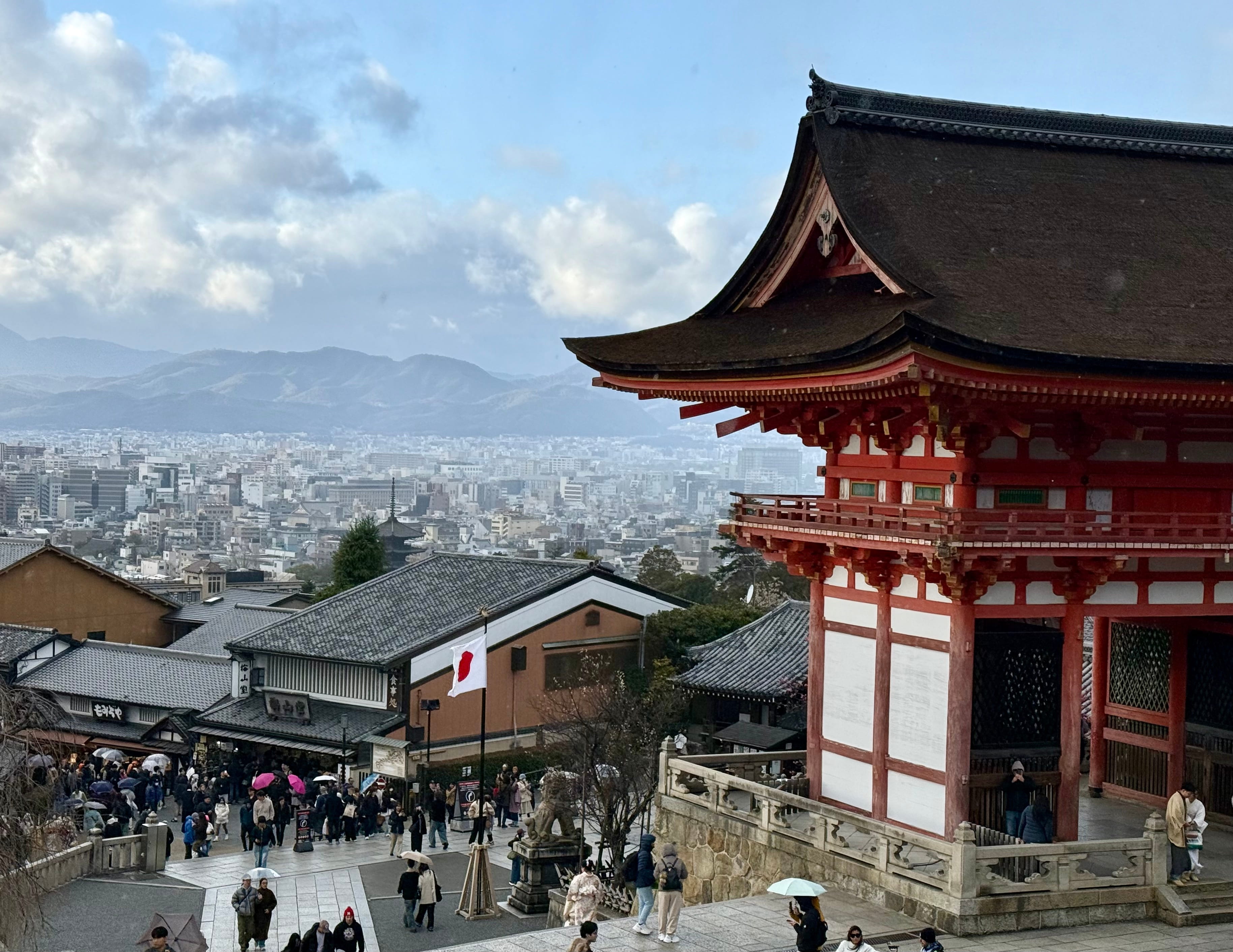
Kiyomizu-Dera in Kyoto
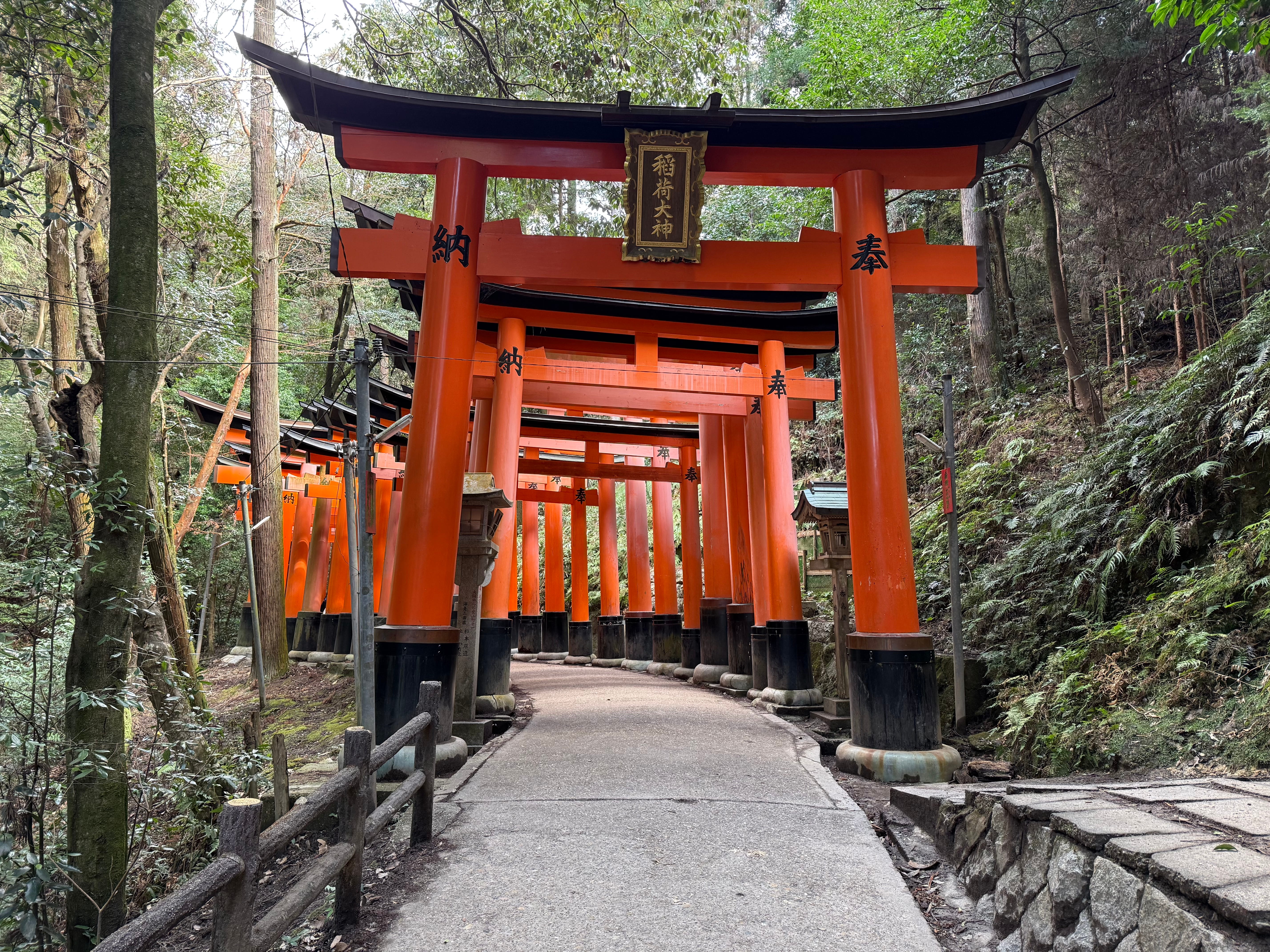
Fushimi Inari-taisha Shrine in Kyoto. Tip, it’s much less crowded as you go further up!
Making the most of rainy days by taking this timelapse at the Shibuya crossing (from the 2nd floor Starbucks)
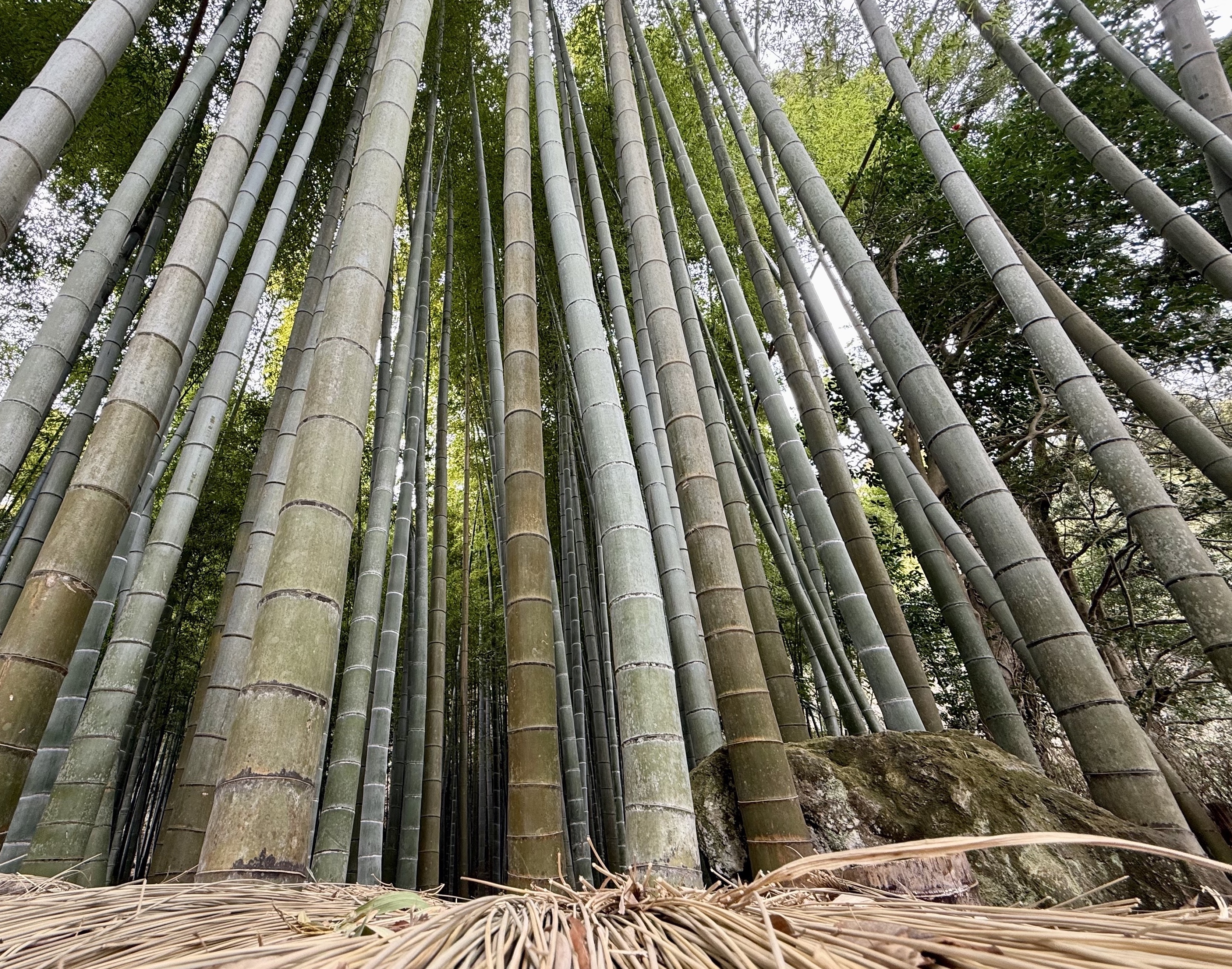
Bamboo forest at the Hokokuji Temple in Kamakura, ~1 hour away from Tokyo
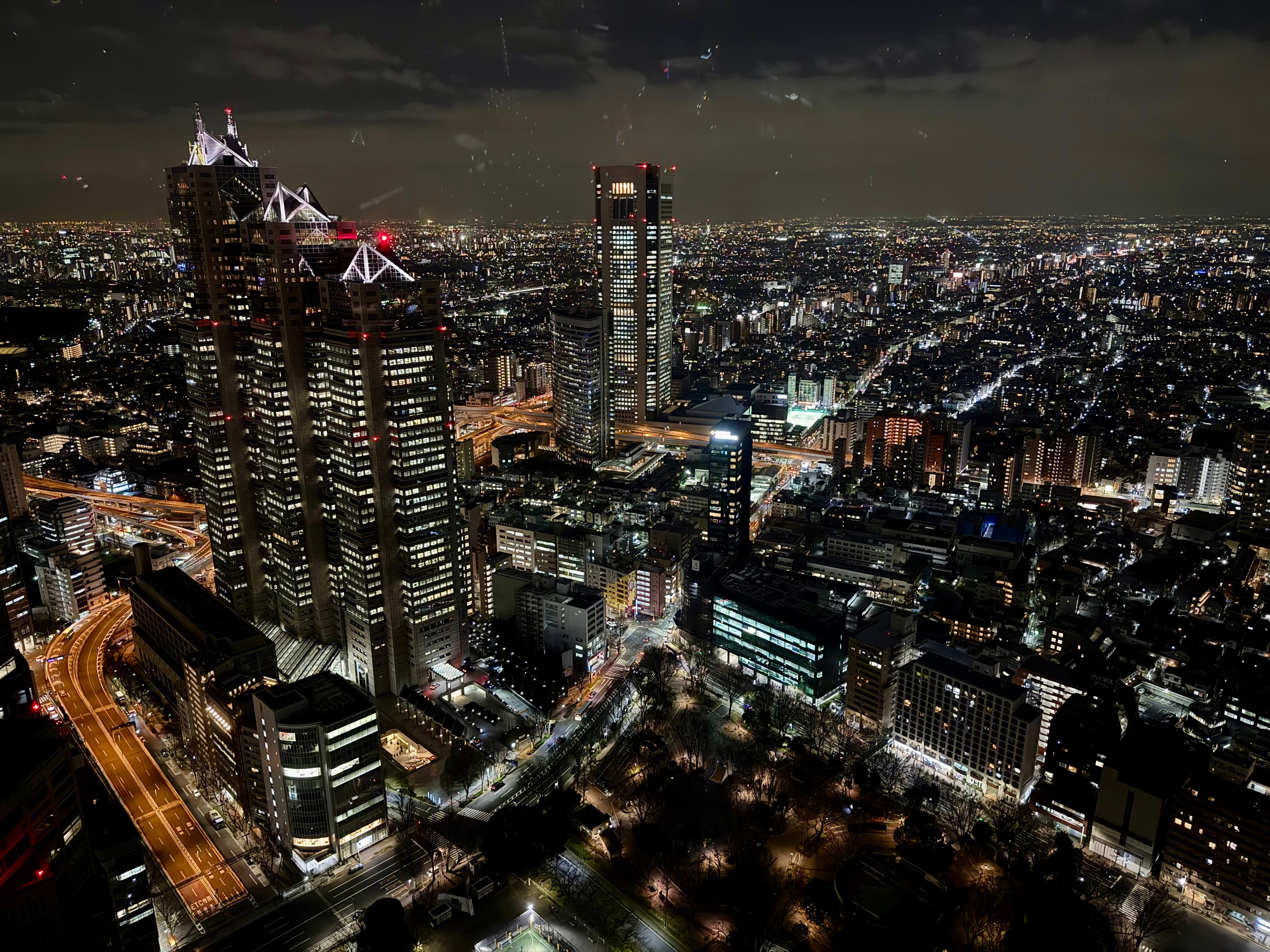
Night view from the Government Building in Shinjuku. They had a piano competition that night, with some really talented Japanese musicians playing (YouTube link)
Retrospective
I would consider this trip a success. Looking back, I probably left a few minutes on the table due to sickness, the corral mistakes, shoe mis-sizing, and jet lag. But for a first marathon, under less-than-ideal circumstances, I’m happy with how it went and all the training build-up for it.
As a plus, I got to do a lot of sight-seeing and try Japanese food, culture and sights with friends/family. I found the trip both energizing, relaxing and exciting all at once. I had high expectations coming in, and Japan absolutely did not disappoint. Now I’m already thinking about the next marathon, maybe NYC? ;)